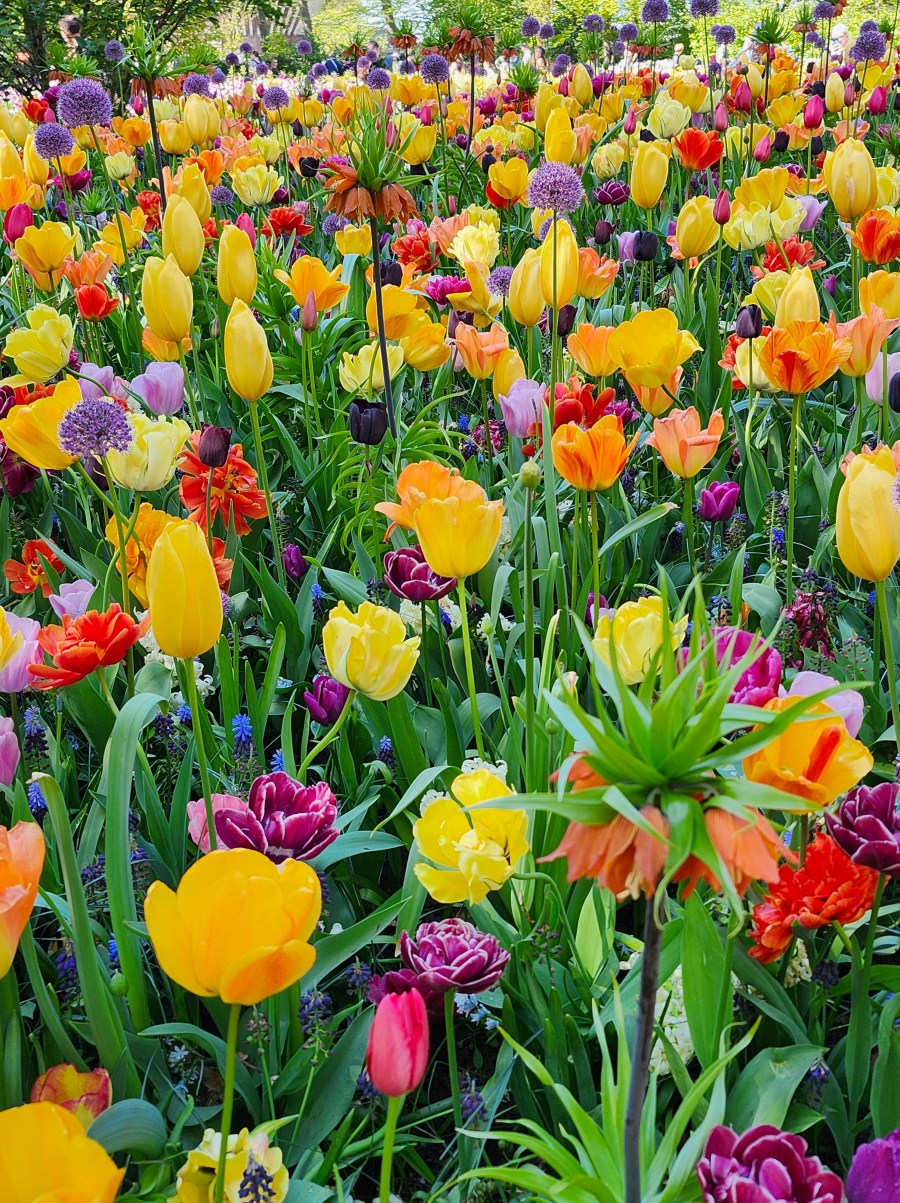
Shortest Day a poem by Susan Cooper

Shortest Day  by Susan Cooper

So the Shortest Day came and the year died 

And everywhere down the centuries of the snow‐white world 

Came people singing, dancing, 

To drive the dark away. 

They lighted candles in the winter trees; 

They hung their homes with evergreen; 

They burned beseeching fires all night long 

To keep the year alive. 

And when the new year’s sunshine blazed awake 

They shouted, reveling. 

Through all the frosty ages you can hear them 

Echoing behind us ‐ listen! 

All the long echoes, sing the same delight, 

This Shortest Day, 

As promise wakens in the sleeping land: 

They carol, feast, give thanks, 

And dearly love their friends, 

And hope for peace. 

And so do we, here, now, 

This year and every year. 

Welcome Yule!

I love this poem by Susan Cooper. For me, it perfectly caresses the moment of the winter solstice in the northern hemisphere: cold and crisp with darkness outweighing light. But also the hope, the expectation that there is light on the horizon, that there will be more light in our lives, that there will be more warmth in our lives—if only we can find our way through this cold darkness. Those sentiments, those hopes seem particularly apt this year.

Good Solstice to one and all! Welcome Yule!!

Grianstad an Gheimhridh to my Gaelic friends who led me to this poem.

Wesołych Świąt to my Polish-American family and friends who bring light and warmth into my live.

Thinking about Hope with Victoria Safford

In these days after celebrating Thanksgiving, I find myself thinking about hope. Whenever hope comes across my awareness, I remember the old proverb, “Hope is a good breakfast, but a bad supper.” I take that as an admonition that it is a good thing to start with hope, but don’t end there. By the time we get to supper, we should have moved at least a few steps in the direction of building something that alleviates some of the suffering in the world, something that resembles a more merciful and just world, community, family, neighborhood, or household. Well, that’s the dream, anyway. Here’s a poem on hope to inspire your dreaming . . . 

Hope  

by Victoria Safford

Our mission is to plant ourselves at the gates of Hope—
Not the prudent gates of Optimism,
Which are somewhat narrower.
Not the stalwart, boring gates of Common Sense;
Nor the strident gates of Self-Righteousness,
Which creak on shrill and angry hinges
Nor the cheerful, flimsy garden gate of
“Everything is gonna’ be all right.”
But a different, sometimes lonely place,
The place of truth-telling,
About your own soul first of all and its condition.
The place of resistance and defiance,

The piece of ground from which you see the world
Both as it is and as it could be
As it will be;
The place from which you glimpse not only struggle,
But the joy of the struggle.
And we stand there, all of us, beckoning and calling,
Telling people what we are seeing
Asking people what they see.

One View of the Garden of Eden After the Eating of the Fruit

It came to pass late one afternoon, in the transitional moments before twilight, just as the sun was caressing the horizon, that Shekinah was strolling through the garden. She was carrying a resplendent, glowing alabaster pot, filled with the fire of the breath of creation, on her way to feed the tree of wisdom and the tree of life. Just ahead of her she saw Adam and Eve, and at first she couldn’t fathom what they were doing. Then it dawned on her, they were dressing themselves in fig leaves.

Shekinah was so shocked, she dropped the pot, and it shattered into billions of shards. How did they know they were naked and needed to cover themselves? There was only one possible answer. They had eaten of the tree of wisdom, the tree of the knowledge of good and evil, before the fruit it bore was ripe. They just couldn’t wait. In one, maybe two, more months, the fruit would have been ripe, creation would have evolved a bit more, they would have grown in knowledge and wisdom themselves. Things would have been so different.

Shekinah tried to tell Yahweh that giving them a prohibitive commandment wouldn’t work. She argued that it would have been better to explain the ripening process to them, to help them understand it was not “no, never” but rather, “no, not just yet.” But now the fruit of the pomegranate tree will never ripen.  Now, Adam and Eve will have to face the consequences of their actions. Now, all of humanity to come will have to devote their lives to the repair of the world, regathering the fire of the breath of creation through acts of mercy and justice, working to find the balance between those two kinds of good works.

My version of the Dogon Cosmic Egg Cosmogony

In the beginning, before there were things, before there was time, Amma came to be. Amma began to pulse and shake, and she took upon herself the shape of an egg. Amma became the great cosmic egg, with four collarbones that were fused, dividing her into earth and air, fire and water, the materials and structure of all the universe. The egg continued to pulse and shake. Seven times it shook until it began to spin. As it spun, it broke open into a spiral, and the shell expanded to fill the universe, and so creation was born. This very birthing brought forth the Dogon people of Mali in the west of Africa.

Amma made the sun and the moon from discs of clay, and the stars from pebbles of clay thrown out into the vastness of the heavens. Amma planted a seed inside herself and created two sets of male and female twins. But something went wrong with the first set of twins. The male would not wait, and rushed his birth before time, and without his female twin. As he broke from the egg, a bit of his placenta few off into space and became the Earth Mother. This first male was called Yurugu, Pale Fox. He became a rogue and a trickster, jealous of Amma’s creativity and creation. Yurugu claimed the earth for himself and determined to make it even better that Amma’s heaven. He strode across the earth, but everywhere he went, everything was dark and dusty and dry. Yurugu planted seeds, and called forth animals, but nothing could flourish there. Hard as Yurugu tried, the dark dryness prevailed. Yurugu walked and thought. He sat and looked at the detritus of his efforts, and saw that he needed his soulmate, his female twin, to bring balance and completion to his efforts. So, he went back to the cosmic egg in search of his other half.

But Yurugu angered Amma with his interference with her creation. Amma banished Yurugu back to earth, where he has forever roamed in the darkness, in the dry desert places, in search of his female twin.

Amma called the second set of twins that she made Nommo. They became the creative spirits of all twinned things of the universe: male/female; left/right; order/disorder; good/evil.

The twins Nommo looked down from the sky and beheld the Earth Mother, naked, and beset with chaos and turmoil. The twins gathered together cosmic fibers that were filled with life forces. Together, the Nommo twins wove those fibers into a garment of green, swaddling the Earth Mother in the finest raiment befitting a most elegant woman. In gratitude for the gifts of the Nommo, Earth Mother spoke the first words heard in the world, words of graciousness and gratitude.

But Yurugu learned of Earth Mother’s powers, he opened his mouth imitating her way of speaking, but no meaningful sound issued from him. He tried, and he tried. He looked up to the moon, and breathed through his mouth, and . . . nothing. Yurugu wanted the power to be heard and understood for himself. Tired of his failed efforts, the next morning, Yurugu hid himself in the shadows, sneaked up on Earth Mother, and stole her skirt of cosmic fibers, which held the power of the word. From that day forward, Yurugu captured the power of language, and has been able to disclose the plans of Amma, the Creator of all.

When Amma saw her son recklessly cavorting, spoiling the bounties of the Earth, Amma decided to create more sets of twins, male and female, male and male, female and female, who would become the ancestor spirits of humanity and would live on Earth according to Amma’s plans. Amma worked to restore balance, countervailing the evil that Yurugu’s deeds evoked.

When the ancestor spirits were born, they traveled up to Heaven to receive instructions for their lives on Earth. Amma welcomed and blessed each of the twins with their own particular wisdom and skill: agriculture, healing, divining, iron-working, woodcarving, weaving and the like.. Amma gave each of the twins one of the eight grain seeds that the Dogon peoples grow to this day. To the eldest ancestor, Amma gave a storehouse for the harvests, a granary made from a clay-lined basket in the shape of the universe.

Amma looked on the workings of creation and was well pleased with its progress. She was about to claim her day of rest when she observed the eldest ancestor making his way to the celestial smithy. There, the eldest stole a piece of the sun and hid the glowing coal inside a bellow. Amma sent the Nommo to retrieve the stolen fire. The Female Nommo threw a lightning bolt at the Eldest Ancestor, but the Eldest held up the bellows, and deflected the bolt. The Male Nommo hurled a thunderbolt, but the Eldest escaped by sliding down a rainbow. At the end of the rainbow, the treasure of fire came to the Earth. As the Eldest tumbled to the Earth, the granary followed, smashing as it hit the ground, spewing out every kind of plant, animal, and human being — all of those beings spreading across the earth.

And that is how the world began.  

Yes to Life by Joseph Campbell

Yes to Life

a poem by Joseph Campbell

The warrior’s approach

is to say “yes” to life:

“yea” to it all.

Participate joyfully

in the sorrows of the world.

We cannot cure the world of sorrows,

but we can choose to live in joy.

When we talk about

settling the world’s problems

We’re barking up the wrong tree.

The world is perfect. It is a mess.

It has always been a mess.

We are not going to change it.

Our job is to straighten out

our own lives.

Joseph Campbell in a Joseph Campbell Companion: Reflections on the Art of Living

I will confess 2 things.

  1. I really like this poem, especially the resounding yes-ness of it. Participating joyfully in the sorrows of the world just seems right to me. It’s got a Buddhist flavor to it.
  2. I will constrain myself, but I so want to edit and revise the poem. I don’t want to embody a warrior’s approach to life. I want to embody a peacemaker’s approach to life. But it’s Campbell’s poem, so I will leave it …I’m not going to change it. My job it seems is to straighten out my own life. (And yes, that’s another word I want to quibble with. Nothing about me is going to be straight. I will gaily leave that too as it is, and dive deeper into understanding and accepting the radiant light within me – within me and you and all of us. Oh, and while, I’m on a roll, I might just as well say it: glow little glow worms, glimmer for all you are worth!!)

About My Obsession with Creation Stories

In the last few blog posts, I’ve written my versions of a few creation stories. Today, I want to take a step back and think with you about creation stories.

I’ve been wondering about my obsession with creation stories. What is it that draws me to them? Well, as I look at the world around me, especially while I am on Cape Cod, I am overtaken by vastness of the ocean and the sand dunes. The endless motion of the ocean waves, the immensity of that much water! I’m silly enough to wonder how many grains of sand there are in one dune, let alone the endless, undulating sweeps of dunes in the National Seashore.

How did this all come to be? Why this and not something else? Why here? And how did we come to talk about the beginnings the way we do? When I wonder about how it all came to be, I wonder even about the beginnings of the beginnings. Could there have been a time, a moment when there was nothing? Just nothing? And then what happened? Who made it happen? How? When? Why?

Or were there always some kinds of beings? Goddesses and Gods who got bored one day and talking among themselves, maybe a bit tipsy on some wine (surely if there were Goddesses and Gods there must have been wine), so maybe they said, “let’s create something to entertain us.” And maybe that kind of thing is how the world came to be.

So I started to read about types of creation stories, and sure enough, there are stories that describe creation from nothing. The creator breathes, thinks, dreams, speaks, laughs, even listens the universe into being—creation ex nihilo—from nothing. One of my favorite groups of creation stories is those where the creator is a craftsperson, who intricately and cleverly shapes all of everything from a primordial substance. One of my other favorite groups of stories are the earth diver stories—there is a pre-existing great sea, a creator sends a creature into the sea to find material, and from the tiniest bit of substance, creates the world—these are just fun stories. And let me not forget emergence stories—there is a pre-existing world which becomes too small or confining, and the people find a way to emerge into a new and grander world. Then there are also stories where two creators bring the universe into being through conflict between them—these stories often spell out hierarchies and class structures. And, and, and. Some folks will detail out nine different kinds of creation stories!

So many kinds of stories. So many possibilities. And to think for so many years I thought the Book of Genesis was the first and last word on all of this! Wow.

cosmic egg

Tibetan Bon cosmic egg creation myth

Bon is an indigenous Tibetan religion with a rich cosmology. The Bon creation story includes not one but two cosmic eggs. I am still struggling with the way many creation stories deal with good and evil, but the Bon story feels nicely balanced to me—maybe because of my affinity for Asian philosophies and Buddhism. This particular cosmic egg story presents us with a narrative of the origin of the universe and the birth of cosmic order from chaos. It doesn’t deal in great detail with the particulars of the creation of the earth and the creatures of the earth, but there are lots of other creation stories that will take us on that ride. If you are looking for a primary source for this story, the Bon myth of the origin of existence is narrated in detail in the Treasury of the Origin of Existence. Here’s my version of it.

The Origin of Existence and the Cosmic Egg

In the beginning, before time and being, there was primordial potentiality. From that potentiality, in the dimension of open and waiting space, thanks to the power of the Immortal, the air element and the winds emerged. The movement of the winds produced a vortex of light that whirled vigorously. The energy of the winds discharged heat, and the fire element formed.

From the cold vapor of the wind and the burgeoning heat of the fire element, water formed as dew and rime (frost on cold objects created by the rapid freezing of water vapor in clouds and fog). Minute particles of matter condensed on those waters, creating the earth element. Those particles, shaken and blended by the wind whirling swiftly in space, formed the earth and its mountains.

From the interaction of the essences of the five basic elements—space, air, fire, water, earth—two cosmic eggs came into being, an egg of light and an egg of darkness.

Through the power of the Luminous Immortal One, from the pure essence of the five elements the Luminous Egg of Light formed, with four fates and eight corners, the size of a seven-year-old female yak. From the power of the Infinite Non-Being, the Cosmic Egg of Darkness formed, with three corners, the size of a three-year-old bull.

The Luminous Egg hatched by the force of its own light, and from the clear light that spread in space were born the numerous deities, beings of light who took on the task of protecting virtuous actions. From the Luminous Egg emerged the Ancestor and Ancestress of the human race, and the Deities who took on the task of sustaining compassion and virtue.

The Cosmic Egg of Darkness hatched in the dimension of black light and emitted obfuscation, obscuration and madness. From the Cosmic Egg of Darkness, beings were born who delighted in annihilation, emptying, interruption and destruction.

In that way, good and evil were born, the earth and all of its beings were created, bringing order to the chaos of unformed potentiality.

Reflections on What the Living Do by Marie Howe

I came across a reference to Marie Howe’s poem “What the Living Do,” in Suleika Jaouad’s, The Book of Alchemy: A creative Practice for in Inspired Life. Jaouad quotes the last few lines, and I was so taken with them I had to search out the full poem.

The lines she quotes are

But there are moments, walking, when I catch a glimpse of myself in the window glass,
say, the window of the corner video store, and I’m gripped by a cherishing so deep

for my own blowing hair, chapped face, and unbuttoned coat that I’m speechless:
I am living. I remember you.

Clearly the poem speaks to heart rending loss, breath suspending loss. And that’s not where I am these days. The poem is set in the dry, icy chill of winter. And that’s not where I am these days (it’s summer and the humidity has been hovering around 80%, the kind of humidity that makes breathing a conscious, effort filled activity). And yet, there is something about those lines, those words—a cherishing so deep—of simple things that constitute the dailiness of living, the simple things we rarely notice, but that make life—not just worth living, but that literally make our life. And the aha line—I’m Speechless: I am living. How mundane. How taken for granted. How perfectly breathtakingly, awe inspiring. I am living. And so are you. And I am grateful.

What the Living Do

Marie Howe

Johnny, the kitchen sink has been clogged for days, some utensil probably fell down there.
And the Drano won’t work but smells dangerous, and the crusty dishes have piled up

waiting for the plumber I still haven’t called. This is the everyday we spoke of.
It’s winter again: the sky’s a deep, headstrong blue, and the sunlight pours through

the open living-room windows because the heat’s on too high in here and I can’t turn it off.
For weeks now, driving, or dropping a bag of groceries in the street, the bag breaking,

I’ve been thinking: This is what the living do. And yesterday, hurrying along those
wobbly bricks in the Cambridge sidewalk, spilling my coffee down my wrist and sleeve,

I thought it again, and again later, when buying a hairbrush: This is it.
Parking. Slamming the car door shut in the cold. What you called that yearning.

What you finally gave up. We want the spring to come and the winter to pass. We want
whoever to call or not call, a letter, a kiss—we want more and more and then more of it.

But there are moments, walking, when I catch a glimpse of myself in the window glass,
say, the window of the corner video store, and I’m gripped by a cherishing so deep

for my own blowing hair, chapped face, and unbuttoned coat that I’m speechless:
I am living. I remember you.

From What the Living Do, copyright © 1998 by Marie Howe. 

Go To The Limits Of Your Longing

Go To The Limits Of Your Longing

Rainer Maria Rilke

translation by Joanna Macy + Anita Barrows

God speaks to each of us as he makes us,
then walks with us silently out of the night.

These are the words we dimly hear:

You, sent out beyond your recall,
go to the limits of your longing.
Embody me.

Flare up like a flame
and make big shadows I can move in.

Let everything happen to you: beauty and terror.
Just keep going. No feeling is final.

Don’t let yourself lose me.

Nearby is the country they call life.
You will know it by its seriousness.

Give me your hand.

Book of Hours, I 59

I kind of love this poem. Every time I read it, a different line resonates with me. Sometimes it’s the title: “go to the limits of your longing.” And I find myself thinking about, wondering about, what is my longing? Not just my longing of the moment (that’s usually pizza or a hot fudge sunday.) But what is my real longing, the longing of my heart, of my soul? That’s a whole other order of longing. And what am I willing to do to move one step closer to fulfilling that longing?

Other times, like today, it’s the lines: “flare up like a flame, and make big shadows I can move in.” Really, both of those lines raise the same kinds of questions. How might I flare up like a flame? Where/what is my passion?

It used to be social justice. Then it was human rights (similar, but a step more practical). For a moment, I was taken with practicing random acts of kindness and senseless acts of beauty. That came to feel a bit shallow. Important, but not enough, maybe.

More to the moment, if I had to say, I would say love. But love as an active verb, as doing. Love in relationship with others, with our world in an ecologically responsible kind of way of being. I remember a course I took with Father Jim Finnegan. I taught us that love means to see the goodness in someone, and to will and act to enable that goodness to grow, for their sake. That kind of love is what I would go to the limits of my longing for. That kind of love flare up like a flame for.  … what about you? What would you go to the limits of your longing for? What lines from the poem most resonate with you?

A Myth-Smithed version of the Huron Earth Diver Story

(Smith: to work with something by heating, hammering, and forging. Myth-Smith: to work with myths by combining, revising, and reshaping.)

Once, before the world as we know it, there was water, wide, deep and vast. The water was populated with fish that swam in its depths, and foul birds that danced on its surface. While the fish swam and the birds flew about and danced on the water, a woman fell through a rift in the sky, tumbling down from the upper world.

As two loons were flying over the waters, they happened to look up and noticed her falling. The loons decided that they could not let her drown, and so they flew beneath her and linked their wings together to form a cushion for her to rest on. While they held her, the loons yodeled and hooted, calling the other animals to aid in their rescue of the woman. All the sea creatures gathered together in response, but it was the great tortoise who consented to relieve the loons of their burden. The loons gently deposited the woman on the back of the tortoise, and the tortoise pledged to care for the woman.

A council of all the sea creatures was called to decide how best to care for the woman, and they decided that she should have earth to live on. The beaver was the first to dive to the bottom of the sea to bring up some earth, but he failed. Musk-rats were the next to dive, but stayed under water so long that when they rose to the surface of the water, they were dead. Each time the tortoise searched their mouths for bits of earth, but she could find none. Many other animals tried to gather a bit of earth for the woman to live on, but all to no avail. Finally, a toad went down to the bottom of the sea. The toad dove so deeply that when she rose, she was nearly dead. But on searching her mouth, the tortoise found a few grains of earth. She gave those to the woman, who took them and placed them carefully around the edge of the tortoise’s shell, and that became the beginning of dry land. The woman then walked from the center of the tortoise’s shell to the east and as she walked, the earth stretched in front of her. She walked to the west, and the earth stretched in front of her. She walked to the north and to the south, and as she walked the earth grew and extended, forming a vast land rich in vegetation and all forms of life. All of this was sustained by the tortoise, who still supports the earth.

This version of the earth diver creation story highlights primordial waters as the source of creation and life—life, which is protected and nurtured through the collaborative and cooperative community. It is also worth noting that not all attempts at finding grains of earth, the substance necessary for sustenance, are successful. Indeed, unsuccessful efforts result in death. This reminds me of the Jewish saying, “You are not required to finish the work, but neither are you permitted to desist from it.” Effort and responsibility are the cost of membership in an interdependent community. And, like planting the seeds of trees, the fruits of our efforts take time to grow and ripen.